WABO PRESIDENT’S REPORT - by Ray Cockerham, CBO
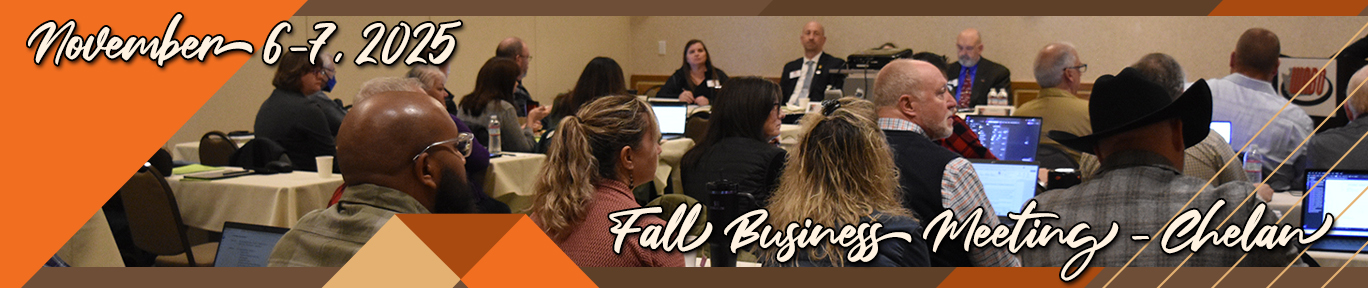
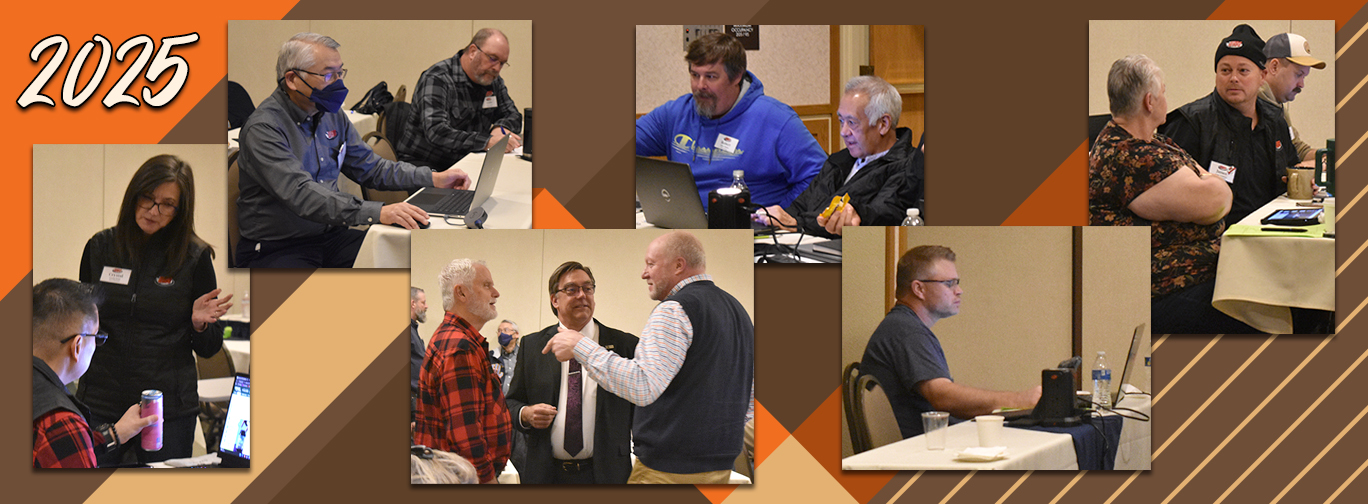
On October 7–8, WABO held its Fall Business Meeting in Chelan, provided a great opportunity to review progress and prepare for the upcoming legislative session. The agenda featured committee work on technical code development, government relations, and education, with members finalizing positions on key legislative priorities for 2026. Guest reports from ICC, WSAPT, SEAW, and other allied organizations enriched the dialogue, while the Code Forum once again served as a lively venue for members to raise emerging issues and share practical solutions. A highlight of the meeting was the professional development session, Know Your Duty, presented by William Hill and Dave Swasey, which emphasized the ethical responsibilities of building officials and reinforced our shared commitment to accountability.
In September, WABO joined the Washington State Association of Permit Technicians in celebrating their 30th Annual Business Meeting. This milestone event honored three decades of permit technician excellence and underscored the vital role these professionals play in the building safety team. WABO’s participation included recognition of long-serving technicians, acknowledgment of emerging leaders, and dialogue on certification pathways and coordination. I was honored to deliver remarks on behalf of WABO, reflecting on WSAPT’s legacy and the importance of permit centers in shaping public trust. The celebration was both retrospective and forward-looking, affirming our shared mission to strengthen workforce development in our industry.
The International Code Council Annual Business Meeting, held at the Huntington Convention Center in Cleveland in October 2025, provided WABO members with opportunities to connect with peers from across the country, attend educational sessions, and participate in governance decisions that shape the future of the International Code Council. WABO’s presence emphasized its commitment to professional development and organizational excellence, aligning with its mission to support building officials and improve municipal processes. During the ICC code hearings, WABO delegates worked within the structured schedule of committee action hearings and public comment hearings.
Most recently, WABO engaged with the Building Industry Association of Washington at their Annual Business Meeting in Vancouver. This venue provided an invaluable opportunity for dialogue between regulators and industry stakeholders. Discussions centered on housing affordability, permit timelines, and the practical impacts of recent code amendments.
WABO’s presence helped clarify regulatory intent and foster constructive feedback loops with builders and developers. These conversations highlighted the importance of transparency, adaptability, and collaboration in addressing Washington’s housing challenges. Opportunities for joint outreach and training were identified, reinforcing the need for continued partnership between building officials and the construction industry. We will continue to peruse the liaison efforts with BIAW.
Since the summer meeting, WABO has advanced several strategic initiatives. Accreditation of Code Officials continues to expand, with new certifications strengthening professional standards statewide. The WABO Chatline has grown as a peer resource for real-time troubleshooting and policy interpretation. Planning for the 2026 Education Institute in Lynnwood is well underway, with expanded tracks and instructor recruitment ensuring a robust program. Benchmarking and staffing model research remains a priority, with efforts focused on developing defensible metrics that can guide permit center operations across jurisdictions.
This season has been filled with insight, humor, and shared purpose. As President, I remain deeply grateful for the trust placed in me and for the dedication of our members, committees, and partners. Together, we are building a stronger, more responsive code community—one that honors tradition, embraces innovation, and remains steadfast in its commitment to public safety and organizational excellence.
Committee Reports
Technical Code Development Committee - Chair Micah Chappell, MBA, CBO
Technical Code Development Committee (TCD) had a special presentation by Matthew Dehr and Dean Raftis of the WA Department of Natural Resources (DNR), providing an overview of the process on of development and the current WUI Hazard Maps. DNR will be doing road shows in January and February, with several webinars in March for those who are unable to attend in person during Jan/Feb roadshows.
TCD discussed the ICC 2027 Committee Action Hearing #2 participation where our contingent was the largest group of code officials in attendance again. TCD then went over our successful statistics for the ICC 2027 Committee Action Hearing #2 that took place in Cleveland, OH. Scholarships are available to WABO members to attend the public comment hearings April 19-28, 2026 in Hartford, CN.
TCD provided updated information on the 2024 WA Code process and delay of the 2024 code adoption. WABO TCD has been participating in the TAG’s for single exit six-story multi-family residential, multi-plex housing up to six-unit structure being regulated by the Residential Code, and discussed Dwelling Unit size for possible changes to the habitable space requirements to align with legislative guidance to allow smaller dwelling units. The SBCC is still working through Group 2 Code change proposals with public comments for Group 1 and Group 2 starting in Feb. of 2026, please access the SBCC website for further information.
TCD meeting schedule is posted on the WABO website in the Code Development page and we are always eager to have participants.
Certification & Registration Committee - Chair Brian Smith, CBO, ACO
At the Fall Business Meeting, an update was shared on the progress that’s been made on WABO’s Washington State Energy Code Plans Examiner Program (WSEC-PEP). This new certification gives jurisdictions a dependable way to identify 3rd party reviewers who have demonstrated their understanding of the WSEC and can deliver consistent, defensible plan reviews, while keeping full authority where it belongs, with the local Building Official.
Highlights included an overview of the WSEC-PEP 1703 Standard, the eligibility point system, qualifying credentials, documentation requirements, and the exam and renewal process. The Residential Exam is now fully loaded in Canvas and ready for launch, and the Commercial Exam is close behind with final plan reading questions being wrapped up.
Members showed their continued support of the program with an approval vote to move the program forward once the last details are finalized. It’s a major step toward strengthening energy code plan review capacity statewide and giving jurisdictions another tool to keep projects moving and reviews consistent. Keep an eye out for its official launch on the WABO website, under the Programs Tab!
Any questions let me know.
Government Relations Committee - Chair Tim Woodard. CBO, ACO
Our committee is already busy at work. In this meeting we were able to finalize our “Legislative Priorities” from this last year and discussed wins for the organization in the last legislative cycle as well as issues we will see in the coming short cycle.
Wins for the organization include the successful efforts to officially remove “Building Permits” from the definition of “Project Permits” to clarify the new implementation of SB 5290 was never meant to place additional constraints on the building permitting process. (HB 1935)
Issues for this next legislative cycle that were discussed include WUI Code fixes to the legislation to clarify mapping and implementation of the code. Clarification to the SBCC roles and responsibilities to produce a custom code with amble time for our members to train on the changes prior to implementation. Continued discussion on use of “small elevators” in lieu of compliance with the ICC / Ansi standard minimum cab sizes. Finally, we know we will see proposed legislation to streamline permitting.
As our lobbyist will remind you, just because this is a short session in the legislature doesn’t mean any less work just less time to get it done. All members are welcome to join the committee and engage in the process. Please email WABO if you would like the meeting invitations.
Outreach Committee - Chair Stacy Criswell, CBO, ACO
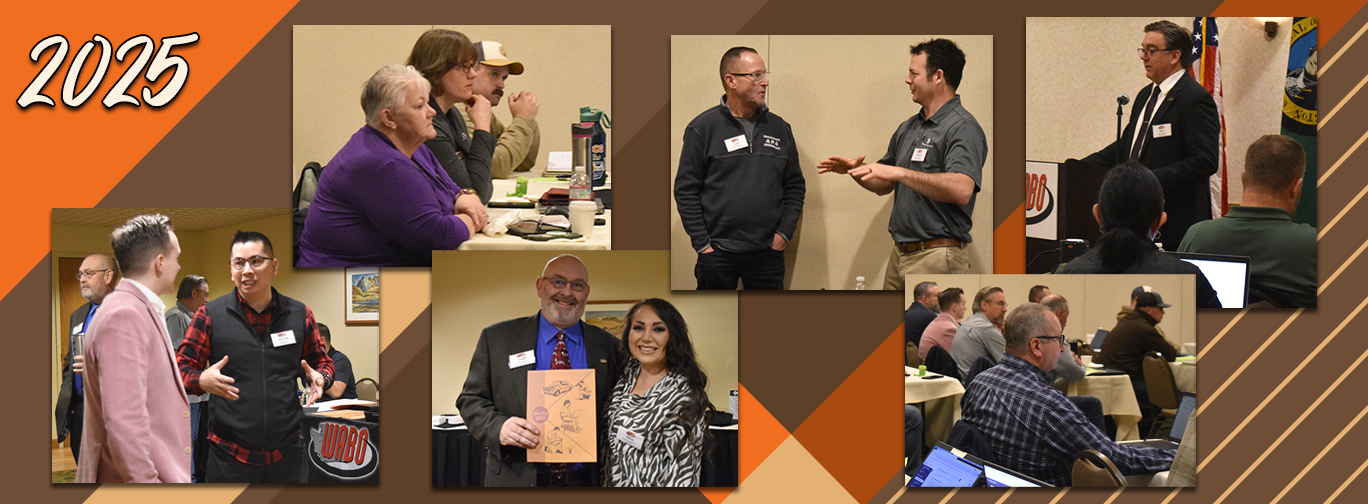
What an incredible meeting we had! This session was filled with engaging discussions on a variety of hot topics and liaison reports, including a visit from a representative of the Building Industry Association of Washington (BIAW) who expressed interest in partnering with WABO on upcoming code amendments and legislative efforts.
We were also thrilled to welcome eight first-time attendees to the meeting. It’s always inspiring to see new faces joining the conversation, and we hope to continue that momentum at future gatherings. If you know someone who would benefit from getting involved, encourage them to attend or explore our scholarship opportunities as a great way to engage more deeply with WABO.
Looking ahead, we’re aware that many jurisdictions are facing budget shortfalls in the coming year. WABO is considering providing a letter of support that jurisdictions can share internally, highlighting our mission, the value of resource sharing, and the essential training we provide alongside local chapters. If you think this would be helpful or if you’d like to assist in drafting the letter… please reach out to me directly at [email protected] so we can connect.
Together, we can continue strengthening our community of building officials and ensuring we all have the tools and support needed to succeed.
Emergency Management Committee - Chair Quyen Thai, MCP, CBO, CFM, MPA
WABO Emergency Management Committee has quite a few things we’ve been working on!
- The continued effort to put together the BSE Coordinator handbook. Now that we have the funds to pay a third party technical writer to assist us in creating the book, there will soon be a draft handbook for review.
- The Building Safety Evaluator training has been a hit this quarter (along with other ATC 20/45 trainings). Seattle Emergency Management did a training last month, King County held an ATC 20/45 training last month, Tacoma held the training back in August where we had 86 individuals sign up and attend that training at the Tacoma Public Utilities Auditorium. Now, there will hopefully be another training in December. The hope is that we will offer more in-person training for new hire staffs and the ask is that staff will volunteer to be on the BSE responder list.
- Speaking of BSE training, please remember that WABO EM and WAserv has a 3-hour online self-paced course for your renewal.
- Last and not least, there’s an ask by Amanda Hertzfeld that local jurisdictions can help support HB1810. What this bill does:
What the bill does:
- Funding Options and Financial Incentives: (Cost $400K)
- Directs the Department of Commerce to study financial incentives for retrofitting URMs, including expanding tax credits and exemptions.
- Studies non-tax incentives for properties that are tax-exempt, helping reduce retrofit costs for public buildings.
- Provides Recommendations to the Legislature for feasible opportunities to reduce the financial burned associated with conducting earthquake retrofits of URMs, supporting public safety, earthquake readiness, and affordable housing.
- URM Inventory: (Cost ~$2M)
- Tasks the Washington Emergency Management Division (WA EMD) with completing the statewide inventory of URMs, leveraging existing data and ground-truthing efforts to ensure accuracy.
- The data will be integrated into the WISAARD database managed by the Department of Archaeology and Historic Preservation (DAHP)
You can find the original bill here: https://lawfilesext.leg.wa.gov/biennium/2025-26/Pdf/Bills/House%20Bills/1810.pdf?q=20251113115003
Education Committee - Chair Ryan Mumma, CBO, ACO
The Education Committee has finalized the 2026 Annual Education Institute schedule and alternative plans have been arranged due to the SBCC delay in code adoption. The 2024 Code implementation date is still set for November 1, 2026 and there has been some discussion that can change as well. Stay tuned for more information in the future. The Education Committee will provide Fall seminars on 'WA State Amendments' if the November 1, 2026 holds to any area that requests the training. The 2026 Annual Education Institute update classes will likely focus on the model code without state amendments.
Finance Committee - Chair Andie Lorenz, CBO, ACO
Andie Lorenz provided the membership with an overview of WABO's 2025/2026 1st Quarter financials.
Accreditation Committee - Chair James Tumelson, CBO, MCP, ACO
The Accreditation Committee is nearing completion of the curriculum refinement for the Code Official Accreditation Program (COAP), a project made possible through state funding received earlier this year.
In parallel, the committee has launched a comprehensive advertising campaign featuring video content that highlights the varied roles of code officials—both in the field and in office environments.
These coordinated efforts are designed to enhance the program’s visibility and appeal, while broadening outreach to prospective students from both the public sector and other professional backgrounds.
TCD Scholarship Reports
2025 Committee Action Hearings Group B #2 - Cleveland, OH
Julius Carreon, SE – City of Bellevue
I would like to thank WABO for the opportunity to attend the 2027 ICC Group B Committee Action Hearing #2 in Cleveland, Ohio, as a representative of the WABO Technical Code Development Committee (TCD). This was my third time attending the ICC hearings in person , and each experience continues to deepen my understanding of the code development process and the collaborative effort behind shaping our model codes.
From October 26–29, I attended the IEBC and Structural committee hearings. As a member of the TCD Structural and IEBC subcommittees, I had the privilege of testifying on behalf of WABO TCD to present comments for three proposals: EB36-25 (plumbing requirements in the IEBC), S52-25 (delegated designs), and S132-25 (pile cap foundation design). The S52-25 comment was developed by the TCD in collaboration with national organizations, specifically the American Institute of Steel Construction (AISC) and the National Council of Structural Engineers Association (NCSEA). This collaboration underscored the value of WABO’s participation at the national level.
Both S52-25 and S132-25 were approved by the committee, while EB36-25 TCD Comment was disapproved by a narrow margin (5–7). However, the committee encouraged the proponents of the four different comments for EB36 to collaborate and refine a unified proposal for the upcoming Public Comment Hearing.
Overall, attending the hearing provided another valuable opportunity to engage directly with national stakeholders and further WABO’s involvement in the ICC code development process. I remain grateful for WABO’s continued support and look forward to contributing to future cycles.
Ray Allshouse, AIA, CBO, ACO – City of Shoreline
I was pleased to attend and contribute to a portion of the second Group B Committee Action Hearings in Cleveland. As it turned out, the executed schedule afforded me to witness essentially the complete code change proposal hearings for IRC – Building, IBC – General, and Administrative provisions which totaled out at 34 hours and 50 minutes. Since the proceedings got ahead of schedule and I had not signed up to participate in the Property Maintenance and Zoning Code changes, I was able to depart late Saturday afternoon.
My contribution to the onsite “side bar” discussions regarding the elevated PV structures culminated in a meeting of the minds with Solar industry proponents and the ICC SEAC Chair. As a result, we gained Committee support for our compromised solution for the related proposals. The objective was to maintain unfettered application of existing building story and fire-separation requirements. This effort affected proposals for both Group A and B changes. Our persistence prevailed but we need to remain vigilant for the PCH in Hartford next Spring.
We are gaining experience in exercising the revised code process strategic nuances. The need to aggressively move the agenda items forward in a timely fashion proved to be a trying exercise for the assembled group. The need to get sufficient testimony before the various committees to move desired actions is a sensitive balance. I was able to selectively support testimony with appropriate “me too” waves. In a few instances we appeared to “win” the testimony “floor fight” but not gain the desired result by the committee. The General Committee appeared to be well prepared as a group and, as such, seemed less moved by the intensity of floor testimony.
Dave Swasey, CBO,ACO - Swasey Consulting, LLC
This was my first time attending ICC hearings and it was very educational. I was unable to attend the entire timeframe due to other obligations but those days that I did attend were full of (many) interesting code change proposals. I attended meetings between Oct 21-24.
The purpose for me to attend was mostly to observe and learn so I can be more active in future hearings, and after attending I see the vital importance of those with code official experience weighing in as many industry representatives were in attendance. Initially the overall process was confusing but it started to make sense after the first day was over. The 2-minute comment (in support), 2-minute (in opposition) and 1-minute periods for rebuttals seem to afford a fair and fluid means to convey feedback and the moderators assure things keep moving, while emphasizing the importance of not repeating what others have already said.
There was one aspect that was made noticeably clear that I found reassuring in terms of what is considered and why, and this came after some children gave “coached” testimony to support tiny homes on wheels being considered for code inclusion. This attempt was not successful and this made clear that committee’s focused heavily on technical merit over emotional strategies. Committee’s weren’t dismissive of such additions to proposal comments and their feedback and remarks often included appreciation and understanding of any emotional ties to a code proposal but they, appropriately, remained with a decision supported through technical merit. This was good to witness as I have questioned how several items made it into the code during my career. Knowing how the process works and why makes a big difference.
I gave testimony on 3 different occasions but I did not think to track exactly which ones, unfortunately. I also participated in multiple instances of “near” testimony that resulted in “me too” waves of the hand, agreeing/disagreeing with comments that occurred before I had a chance to speak.
Thank you for this opportunity to support WABO’s mission to ensure codes we use are up to date, concise and remain as minimum standards.
Quyen Thai, MCP, CBO, CFM, MPA - City of Tacoma
I was able to attend the ICC Committee Action hearings in Cleveland, OH and it went as one might expect. When I was able to attend after my
membership council meeting, I was able to get up and argue one of my proposals and 3 other proposals and get them through or not through (depending on the stance I took). Normally, in the past, it was usually 50/50 but this time through, the ones I testified on I was pretty much 100%. I
think I’m getting better at testifying but still not perfect yet! Maybe someday I’ll be just like Jeff Shapiro or Marcelo.
Hoyt Jeter, PE - City of Tacoma
This conference ensures that the next generation of building codes reflects safety, sustainability, and affordability, while incorporating broad input from the architecture, engineering, and construction community. The International Building Code Conference brings together industry professionals, code officials, and stakeholders to review and discuss proposed changes to the International Codes (I-Codes). This event is part of the ICC’s updated three-year code development cycle, designed to ensure thorough vetting and consensus-building for the 2027 I-Codes. I had the pleasure of attending both hearings. At first, I was hesitant about the two hearing processes. But I found it worked pretty well, and I assume more changes will come in the future. I will give an example of how it worked well. For those unfamiliar with the change, below is a summary
I thought it essential to list the new procedures for code changes to the International Code produced by the ICC.
- New Development Process:
- Year 1 & 2: Two Committee Action Hearings (CAH) for Group A and Group B codes, enabling deeper review and response to proposals.
- Year 3: Joint Public Comment Hearings and Online Governmental Consensus Vote for all changes.
- Goals:
- Improve transparency and stakeholder engagement.
- Provide opportunities for proponents to refine proposals and build consensus.
- Align referenced standards with consistent timelines.
- Highlights:
- Discussions on emerging topics such as sustainable materials, high-rise timber regulations, and egress requirements.
- Interactive sessions on how to participate in the ICC code change process.
This conference ensures that the next generation of building codes reflects safety, sustainability, and affordability, while incorporating broad input from the architecture, engineering, industry, and construction communities.
I have included an example of a proposal.
The code change proposal EB95-25 for the IEBC section 1002.1, Compliance with the building code for special uses, submitted by Jeff Grove, was disapproved by a vote of 10 to 0 during the first committee action hearings. The reason for disapproval was as follows.
EB95-25
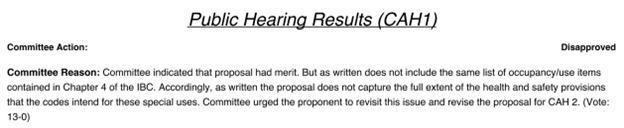
Jeff Grove responded by improving his proposal, including the committee's rationale for reconsideration. With the suggestion from the committee, why was it disapproved? In addition, floor modifications were made to further clarify the intent, which was great to have this option.
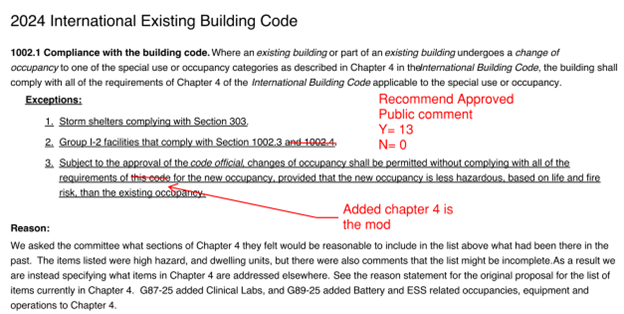
In addition, there was a future modification from the floor, as you can see, they made a mod to delete the words “the code.”
With his hard work and consideration of the reasons, the proposal was improved and approved by a vote of 13 to 0. This allowed the participant to produce a better code change proposal for adoption in the next code cycle. Now this will go to online voting by jurisdiction for final approval.
Sincerely, I would like to express my appreciation to WABO for allowing me to attend the hearing with a scholarship. It is by far the best way to learn the code and reasons behind code items. It been one of the best things in my career to be able to attend this.
Stacy Criswell CBO, ACO - City of Monroe
I’ve said it before, and I will say it again… being involved in code development either at a local level, state level or national level is important. Even if it’s just listening for background noise while you’re working on plans or driving to the next job site, you can learn something. This insight really helps you see how codes are developed, talked about (sometimes to death…) and ultimately how thorough the process really is. It’s not just a couple people in an ivory tower making decisions without input from leading experts in their field.
So, what did I learn at this code hearing… I really learned that building officials need to pay attention. As an example, RB121-25 is a proposal to modify stair rise and run back to an 8 ¼” rise and 9” run. This had a lot of testimony trying to change the committee’s decision, but they voted again 6 to 5 to recommend the change. So, at the next hearing we need building officials to vote in opposition to the committee’s recommendation if you like the 7 ¾” x 10” rise/run.
This is just one example of the hundreds of proposed changes, but without our amazing WABO TCD volunteers, things like this could easily get skipped. So, I encourage you to get involved even just a little bit and learn how the codes get developed. I hope to see you at a future code hearing!
|